
Welding Safety on Pakistani Construction Sites — A Complete Guide
Essential occupational safety practices for contractors, site engineers, and welders in Pakistan — covering fumes, electrical shock, radiation, PPE, and fire watch.
Direct Answer for Safety Officers & Site Managers
The Six Major Hazards of Arc Welding in Construction
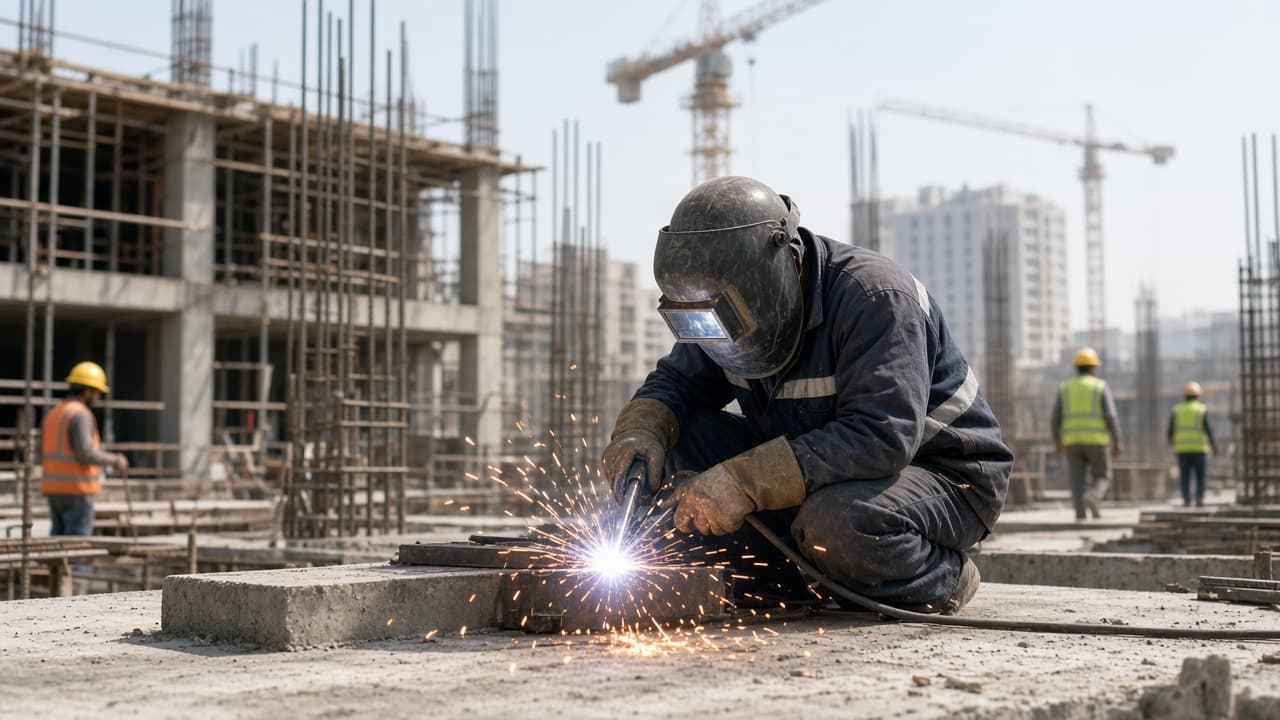
Construction sites in Pakistan present dynamic safety challenges due to open scaffolding, unpredictable weather, and concurrent trades working in close proximity. Contractors must actively safeguard against these six core hazards:
| Hazard Category | Specific Risk to Personnel | Primary Control Measure |
|---|---|---|
| Welding Fumes & Gases | Acute metal fume fever, chronic lung irritation, neurological effects from manganese and zinc fumes | Adequate local exhaust or natural cross-ventilation; approved particulate respirators (N95/P100) |
| Optical Radiation (UV & IR) | Severe corneal burns ("arc eye" or photokeratitis), permanent retinal damage, facial skin burns | Welding helmets fitted with correct shade filter (Shade 10–12 for SMAW); UV-absorbing safety screens |
| Electric Shock | Ventricular fibrillation, severe internal burns, secondary fall injuries from scaffolding | Reliable equipment earthing, intact cable insulation, dry leather gloves, automatic voltage-reducing devices (VRD) |
| Fire & Explosion | Ignition of nearby combustible scaffolding, diesel stores, formwork, or painting solvents | 10-meter clearance zone around hot work, dry chemical fire extinguishers, mandatory fire watch |
| Thermal Burns & Flying Slag | Severe skin burns from molten spatter, eye lacerations from explosive slag chipping | Split-cowhide leather welding aprons and sleeves; clear impact-rated safety spectacles under helmet |
| Excessive Noise | Permanent sensorineural hearing loss from carbon arcing, needle scaling, and angle grinding | Earplugs or noise-reducing earmuffs compliant with OSHA 85 dBA 8-hour limits |
Essential Personal Protective Equipment (PPE) Checklist
Never permit a welder or helper to strike an arc without the full mandatory PPE ensemble:
- Welding Helmet: Fitted with standard shade 10 to 12 passive lenses or an auto-darkening filter (ADF) compliant with ANSI Z87.1 / EN 175.
- Impact-Resistant Safety Glasses: Worn continuously under the welding hood to protect against sharp flying slag when deslagging with a chipping hammer.
- Heavy-Duty Leather Welding Gloves: Chrome-tanned split cowhide leather gloves that extend past the wrist to shield against spatter and accidental contact with hot stubs.
- Flame-Resistant Work Clothing: 100% heavy cotton or treated leather jacket without open pockets or turned-up cuffs where hot sparks can lodge. Synthetic fabrics (polyester/nylon) are strictly forbidden because they melt into flesh upon contact with molten metal.
- Steel-Toe Safety Boots: Oil-resistant, high-ankle leather boots with steel or composite toe caps protecting against dropped heavy steel sections.
- Respiratory Protection: Well-fitted half-mask respirators equipped with P100 or particulate filters when welding in semi-enclosed areas or on galvanized steel.
Job-Site Electrical Safety Checklist
Electric shock is among the most hazardous risks in Shielded Metal Arc Welding (SMAW), particularly during humid Karachi summers or Punjab monsoon conditions:
- ✓Dedicated Machine Earthing: Connect the equipment grounding lead directly to a proven earth stake or structural ground before powering on.
- ✓Ground Clamp Placement: Attach the work return clamp as close as possible to the weld joint to avoid stray currents travelling through crane cables or rebar.
- ✓Cable Insulation Integrity: Inspect cables daily for cuts, exposed copper strands, or frayed joints. Taped splices within 3 meters of the electrode holder are strictly prohibited.
- ✓Electrode Holder Condition: Ensure the holder (stinger) has fully insulated jaws with no exposed conductive surfaces.
- ✓Dry Environment Verification: Never weld while standing in standing water or in heavy rain. If working in damp basement rafts, stand on dry wooden duckboards or rubber insulating mats.
- ✓Power Down Before Adjustments: Always switch off the welding power source at the main breaker before changing cable connections or undertaking maintenance.
Hot-Work & Fire Prevention Procedures
Molten welding sparks from E6013 electrodes can travel up to 10 meters (35 feet) horizontally and fall through floor openings onto flammable materials:
- Survey the Hot-Work Zone: Remove all combustible materials (wooden formwork, cardboard packaging, chemical drums, diesel cans) within a 10-meter radius of the welding area.
- Cover Non-Movable Combustibles: Shield immovable wooden scaffolding, plastic pipes, and electrical cables with certified fire-retardant welding blankets.
- Position Fire Extinguishers: Ensure at least two inspected dry-chemical powder (DCP) or carbon dioxide ($CO_2$) fire extinguishers are positioned within 5 meters of the hot work.
- Establish a Dedicated Fire Watch: Post a trained fire watch equipped with an extinguisher during hot work and maintain vigilance for at least 30 to 60 minutes after welding terminates to detect smouldering sparks.
- Inspect Floor & Wall Openings: Cover expansion joints, sleeve penetrations, and cable risers with metal sheet or fire blankets to prevent sparks falling to lower floors.
Confined Space & Height Safety
- Working at Heights: Welders operating on suspended scaffolds, towers, or steel columns must wear a full-body safety harness with a flame-resistant Kevlar lanyard anchored to an independent lifeline.
- Ventilation in Enclosed Areas: When welding inside tanks, elevator shafts, or basements, provide continuous forced mechanical exhaust ventilation. Never introduce pure oxygen to ventilate a confined space.
Frequently Asked Questions (FAQ)
What shade lens should be used for E6013 stick welding? For welding with 2.5 mm to 4.0 mm E6013 electrodes at 60 to 180 amperes, a **Shade 10 or 11 lens** provides optimal optical protection against ultraviolet (UV) and infrared (IR) radiation while allowing clear view of the weld puddle.
How do you treat arc eye on a job site? Arc eye causes intense pain, burning, sensitivity to light, and sensation of sand in the eyes. Move the injured worker to a dark room, apply cold sterile compresses, avoid rubbing the eyes, and consult a qualified medical professional immediately for soothing ophthalmic drops.
Can wet electrodes cause electric shock? Yes. Wet or damp electrode coatings conduct electricity, significantly increasing the risk of secondary electric shock to the operator. Discard or properly re-dry moisture-damaged electrodes before striking an arc.
Technical Resources & Support
Share this technical resource
Published by Perfect Craft (Pvt.) Ltd., Karachi, Pakistan. For questions or technical verification, reach our engineering desk at [email protected].
Next step
Request current technical documents, check dealer availability, or ask about bulk supply. Every form submission returns a reference ID for follow-up.